
- Using AI to brainstorm or understand concepts is almost always permitted; using AI to write sections you submit as your own is almost always prohibited
- Your strongest defense against false AI accusations is keeping version histories, prompt logs, and research notes that document your writing process
- Current AI detection tools are fundamentally unreliable: false positive rates range from 10–20%, and detection alone is never sufficient proof of misconduct at most institutions
- The most effective defense against AI accusations is proactive documentation — Google Docs version history, Track Changes in Word, and prompt trails are your best evidence
The Line Between Helpful and Dishonest
You’re not alone if you’re worried about whether using AI for your assignments could get you in trouble. The line between helpful and dishonest is blurrier than ever, and the anxiety of being falsely accused can be just as terrifying as the fear of actually cheating.
Here’s what every student needs to know right now: the most universities have updated their policies, detection tools have matured (and hit clear limits), and the line between permitted and prohibited AI use has been drawn with more precision. But the pressure on students to understand those boundaries hasn’t gone away — it’s gotten more complicated.
This guide covers the actual rules as they stand in 2026, how to use AI legitimately without putting your academic standing at risk, how to defend yourself if you’re falsely accused, and how to declare your AI use honestly. Whether you’ve been using AI responsibly and want to stay on the right side of policy, or you’re worried about how to protect yourself from false accusations, you’ll find practical frameworks and real strategies here.
The New Rules: How University Policies Actually Changed in 2026
In 2023 and 2024, most institutions scrambled to write AI policies from scratch. By 2026, the picture is clearer and more consistent across institutions in Europe and North America. The majority of universities now operate on a framework that distinguishes between AI as a learning aid and AI as a substitute for your own thinking.
The universal principle is simple: work submitted for assessment must represent your own thinking, knowledge, and expression. AI can assist. It cannot replace.
| AI Use Type | Typical Policy Status |
|---|---|
| AI for understanding concepts and ideas | Permitted |
| AI for brainstorming and ideation | Permitted |
| AI for language and grammar checking | Permitted (often with disclosure) |
| AI for improving clarity of your own draft | Permitted at most institutions |
| AI for generating text you submit as your own | Prohibited |
| AI for summarising sources you have not read | Varies, often prohibited |
| AI for writing code in CS coursework | Varies by course |
| AI for translation in language courses | Often prohibited |
What’s changed most dramatically is not the policy language itself, but the enforcement. More institutions now treat AI use as a spectrum rather than a binary. Some schools have created explicit permission categories — green, yellow, and red — to help students understand exactly where their use falls. If your institution hasn’t updated its policy yet, a brief email asking for clarification is always appropriate and demonstrates good faith.
The shift from prohibition to nuanced policy matters because it means students who used AI responsibly through 2024 and 2025 are now operating within a clearer framework than when policies were first being drafted.
Your Defense Toolkit: How to Protect Yourself from AI Accusations
Even if you’ve done nothing wrong, AI accusations can happen. They’ve happened to students with clean records who were flagged by detection tools and then required to defend their work. Being prepared is not cynical — it’s responsible.
Version History
If you write in Google Docs or Microsoft Word, version history is your single most powerful piece of evidence. Google Docs automatically saves snapshots of your document over time. Word’s Track Changes feature records every edit. When an accusation comes, those logs can demonstrate that your paper evolved through drafts, not that it was copied in from somewhere else.
A professor looking at your Google Docs history can see the gradual development of your argument, the revision of sentences, and the progression from rough draft to final version. That timeline is difficult to fabricate retroactively.
Prompt Trails and Research Notes
Keep a record of the prompts you fed into AI tools. If you asked ChatGPT to explain a concept, saved a copy of the response, and then wrote your own paragraph about it, that chain of evidence matters. Screenshots or exported logs showing your search queries, highlighted PDFs, and research notes create a paper trail that demonstrates genuine engagement with the topic.
Audit Logs from Educational Platforms
Canvas, Blackboard, and similar platforms often keep submission timestamps and login records. If you were accused of using AI on a timed assignment, those logs can show when you accessed the platform and when you submitted your work. They can’t prove you didn’t use AI, but they can help establish that you completed the assignment under the conditions your instructor specified.
What to Do When Accused
Remain calm. Request the specific evidence being used against you. Understand the standard of proof your institution requires. Most universities treat detection tool scores as one input among several, not as definitive evidence of misconduct. You have the right to see the evidence, to request a review of your work alongside your other submitted assignments as context, and to demonstrate authorship through drafts, notes, and process documentation.
The process from accusation to resolution typically follows a pattern: an initial suspicion, a request for evidence, a meeting or hearing, and a final decision. Understanding that structure helps you navigate it without panic. If your case involves serious consequences, consulting an experienced attorney can help you understand your rights and your options.
The Traffic Light Framework: Green, Yellow, Red AI Use
The most practical framework for understanding AI use in academia right now is the traffic light system — a simple categorical breakdown that maps to how most universities now classify AI assistance. The visual below shows the three categories and the scenarios that fall into each.
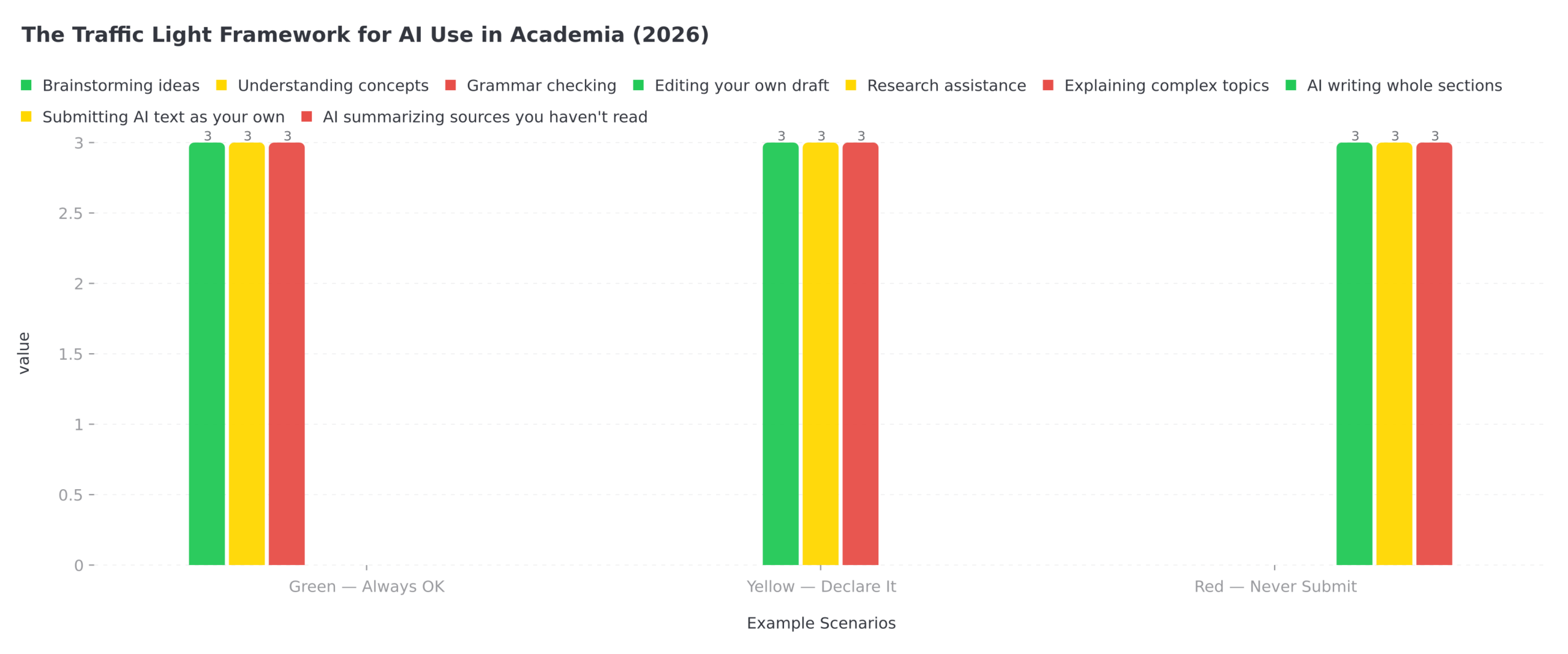
Green: Always Permitted (No Declaration Needed)
These uses are almost universally allowed because they don’t replace any intellectual work you would otherwise do.
- Brainstorming ideas for an essay topic or project
- Understanding difficult concepts before you engage with them in your own writing
- Grammar checking or language correction, especially if English is not your first language
- Thesaurus-style word suggestions to improve clarity of your own phrasing
Real scenario: You’re writing a paper on climate policy and you ask an AI to explain three theoretical frameworks used in environmental policy. You read the explanations, understand the frameworks, and choose which one to apply in your essay. You write the essay yourself. That’s green.
Yellow: Permitted With Declaration (Must Be Acknowledged)
This is where most students need to pay attention. AI is allowed, but you must declare its use because it’s contributing to the cognitive work you’re submitting.
- Editing your own draft for clarity or structure
- Research assistance — using AI to find sources or organize notes, then writing from those sources
- Explaining complex topics as a study aid
- Checking whether your conclusion follows from your introduction
Real scenario: You’ve written a draft paragraph. You paste it into an AI and ask “is this argument clearly made?” The AI identifies a logical gap. You rewrite the paragraph to address it. You declare in your submission notes that you used AI to review your argument structure. That’s yellow.
Red: Prohibited (Academic Misconduct)
These uses are almost always considered academic misconduct because they represent AI-generated work submitted as your own.
- Submitting AI-generated text as if you wrote it
- Asking AI to write sections of your essay, especially when you’re running out of time
- Having AI summarize academic papers you were supposed to read, then citing those papers as if you read them
- Using AI to write in a style that doesn’t sound like you on assignments where your voice matters
Real scenario: You paste an essay prompt into an AI and submit what it produces. That’s red, plain and simple.
The Honest Student’s AI Workflow: What Legitimate Use Actually Looks Like
Using AI ethically isn’t about avoiding AI. It’s about maintaining intellectual ownership of your work. The students who use AI most effectively aren’t the ones who use it the most. They use it at specific moments where it adds genuine value, and they keep the thinking their own.
Here’s what legitimate AI use looks like in practice, based on the examples universities now use to distinguish permitted from prohibited use:
Understand a difficult concept → write about it yourself. Ask AI to explain a topic you’re struggling with. Read the explanation. Then write your own paragraph about it, using your own voice and your own understanding.
Get feedback on argument structure before finalizing. Paste your draft and ask the AI to identify logical gaps. Don’t let it rewrite the paragraph for you — use its feedback to rewrite it yourself.
Check that your conclusion follows from your introduction. Ask the AI to analyze whether your evidence actually supports your thesis. Then revise your argument based on whatever it flags.
Grammar review if you’re writing in a second language. Write your essay yourself and ask an AI to correct grammatical errors without changing your argument or voice.
Summarising papers you’ve already read to check comprehension. Read the source yourself. Then ask AI to summarize it so you can check whether you understood it correctly. Don’t use the summary as a substitute for reading.
What to avoid: Never ask AI to generate any text you plan to submit. Never ask AI to summarise sources as a substitute for reading them. Never use AI to write in a style that doesn’t sound like you, especially on assignments where your personal voice is part of the grading criteria.
The key question is always the same: who produced the core intellectual content? If you wrote it, AI can help you refine it. If AI wrote it, you’re responsible for not submitting it as your own.
If You’re Accused of Using AI: What Happens Next
Being accused of academic misconduct for AI use is stressful. Your academic career is at risk, and the process can feel opaque. Understanding the typical sequence of events helps you stay composed and respond strategically.
Initial Steps: Stay Calm, Request Evidence
When you’re told that a professor or administrator suspects AI involvement in your work, your first instinct might be panic. Resist it. The most productive immediate response is a conversation, not a formal confrontation.
Ask to see the specific evidence being used against you. Request that your case be reviewed alongside your other submitted work as context. Understanding the standard of proof your institution requires is critical: most universities must show that misconduct is more likely than not before disciplining a student, and detection scores alone rarely meet that threshold.
Building Exculpatory Evidence
Start gathering your defense materials immediately:
- Export your Google Docs version history or Word Track Changes logs
- Save screenshots of your AI prompt trails and search queries
- Collect your research notes, highlighted PDFs, and annotated readings
- Document your Canvas or Blackboard submission timestamps
- Prepare to explain your writing process: how you structured the essay, why you chose certain arguments, what you struggled with
The Meeting or Hearing
When you meet with your professor or an academic integrity panel, focus on demonstrating your understanding of the work. Effective verification questions include: “Can you talk me through how you structured this essay?” “What was the hardest part of this piece?” “If I asked you to write the next paragraph right now, on a related topic, could you do that in a similar style?”
A learner who wrote their work can describe their thinking process. A learner who submitted AI output often cannot explain why they made specific choices. Even if you’re innocent and genuinely confused about whether the accusations are accurate, being able to explain your own work is the strongest possible evidence.
Campus Support Resources
Don’t handle this alone. Contact your university’s student advocacy office, student union, or academic support services. Many campuses have advisors who specialize in academic integrity procedures. If the consequences are severe, consulting an experienced attorney can help you navigate your rights and your options through the disciplinary process.
What Detection Tools Actually Can and Can’t Prove
Turnitin’s AI writing detection — the most widely used tool — analyses statistical patterns in text: sentence structure predictability, perplexity scores, and stylistic uniformity. It gives a percentage score, but that score is not definitive evidence.
GPTZero and similar tools work on similar principles, looking for patterns characteristic of large language model output. But the independent research is clear: these tools are unreliable for academic misconduct cases.
The Problem with False Positives
Weber-Wulff et al. (2023) conducted the largest independent evaluation of AI detection tools, testing 14 tools across 126 documents. The findings are sobering:
- Detection tools incorrectly flagged human-written text as AI-generated in 10–20% of cases. In a school of 1,000 learners, this means 100–200 learners could be falsely accused each year.
- For English-as-a-second-language (EAL) learners writing in a non-native language, false positive rates were even higher, because their writing patterns more closely resemble AI output.
- Simple edits beat detection. Learners who change a few words or sentences are hard to spot. Adding intentional errors also makes AI text undetectable.
- Detection tools themselves use AI. The detection AI has its own biases and limitations, and its confidence scores are not probabilities in any statistically meaningful sense. A “95% AI-generated” label does not mean a 95% chance the text was AI-generated.
A professor who knows your previous work noticing a sudden change in writing quality, vocabulary, or analytical depth is far more common than tool-based detection. The human factor matters more than the algorithm.
If detection tools aren’t proof, what is? The practical conclusion is straightforward: do not use AI detection tools as the sole basis for accusing a learner of misconduct. They can be one data point among many — combined with knowledge of the learner’s previous work, in-class performance, and the submission process — but they should never be the deciding factor.
For more details on how AI detection actually works, see our guide on AI content detection.
How to Declare Your AI Use: Transparency Made Simple
An increasing number of universities require explicit disclosure of AI use. Even where not required, disclosure is a good practice that demonstrates integrity. The key is to do it clearly and honestly.
A standard disclosure statement you can adapt to your institution’s format:
“In completing this assignment, I used [AI tool name] to [specific purpose, e.g., check the logical structure of my argument and to improve the clarity of my prose]. All substantive analysis and conclusions are my own.”
Four Attribution Methods
When you explain how AI was used in your work, specify these four elements: the name of the AI tool, the purpose of the use, the extent of the AI influence, and the role of human oversight in reviewing and verifying the AI output.
There are four practical ways to attribute AI use in your work:
- List AI use in the acknowledgments section: “The authors acknowledge moderate use of ChatGPT in reviewing initial drafts of this material and suggesting revisions for clarity. The final content was reviewed and edited by the authors, who take full responsibility for the work.”
- Cite the AI like a source in footnotes, endnotes, or bibliography, using APA, MLA, or Chicago style.
- Declare the use of AI in methodology: “AI-assisted data analysis was used to a minimal level, identifying patterns and outlier test results which were then reviewed for accuracy by the authors.”
- Inline attribution within the text: “According to a summary generated by ChatGPT and reviewed for accuracy by the author, the main themes of this topic are…”
For a deeper dive into the proper methods of attribution, see our guide on how to properly attribute sources.
Template Disclosure Statement
Here’s a practical template you can customize:
“I used [tool name] for [purpose]. All substantive analysis, argument structure, and conclusions are my own. I used [tool name] to [review drafts / check grammar / explain concepts / organize notes]. The final content was reviewed and edited by me.”
If your institution has a specific disclosure form or section, use that. If not, add a brief note at the end of your submission. The goal isn’t to hide what you did or pretend you did everything alone. It’s to demonstrate that you engaged in the cognitive work of transforming understanding into your own written argument.
What Most Guides Get Wrong
A lot of advice about AI in academia tells students to avoid AI entirely. That advice is both unrealistic and counterproductive. AI is here, and in many cases, it’s going to be expected — or even required — by your professors. The goal isn’t to avoid AI. It’s to use it responsibly and document your work transparently.
Another common misconception is that using AI to check your grammar or improve clarity is cheating. At most institutions, using AI to improve the clarity and grammar of writing you produced yourself is explicitly permitted. Submitting AI-generated text as your own is what crosses the red line. The distinction matters for your academic record and, more importantly, for whether you actually develop the analytical and writing abilities your degree is designed to build.
If you’re overwhelmed by all the policy details, a single starting point is this: read your institution’s academic integrity policy and the department-level guidelines for your courses. Check whether your syllabus mentions AI. If your professor hasn’t updated their policy for AI, ask directly — a brief email asking for clarification is always appropriate and demonstrates good faith.
For a broader look at how academic institutions approach integrity, see our guide on academic integrity policies.
Bottom Line
The conflict between AI and academic integrity isn’t fundamental. The conflict arises when AI is used to produce work that students present as their own thinking. Using AI to improve, question, and develop your own thinking is a legitimate and increasingly expected professional skill.
The distinction matters for your academic record. But it also matters for whether you actually develop the analytical and writing abilities your degree is designed to build. Students who use AI responsibly aren’t cheating — they’re using a tool to learn better. Students who use AI dishonestly aren’t being clever; they’re short-circuiting the very skills a university education is supposed to develop.
If you want help verifying the originality of your work before submission, you can check for plagiarism in your paper using our free online plagiarism checker to catch accidental similarities before they become problems.
The most useful principle to carry forward: who produced the core intellectual content? If you did, use AI as a learning aid and disclose it. If AI did, don’t submit it as your own. Keep that line clear, document your process, and you’ll navigate AI in academia with integrity intact.
For a comprehensive overview of plagiarism prevention strategies that apply across all academic contexts, see our complete guide to plagiarism.
FAQ
Will my university know if I use AI?
If you use AI for brainstorming, concept understanding, or grammar checking — the green category — most universities won’t know in every instance. But sustained AI use across multiple submissions creates patterns that professors notice. Your writing quality and analytical depth will also not improve over time if you outsource the thinking, which has academic consequences beyond integrity investigations.
Is it plagiarism to use AI to improve my writing?
At most institutions, using AI to improve the clarity and grammar of writing you produced yourself is permitted. Submitting AI-generated text as your own is plagiarism. The line is: who produced the core intellectual content?
What if my professor hasn’t updated their policy for AI?
If your institution or course has no clear policy, ask your professor directly what is and is not permitted. A brief email asking for clarification is always appropriate and demonstrates good faith.
Can I use AI in my dissertation or thesis?
Dissertation policies vary significantly. Many institutions now permit AI-assisted research and writing at postgraduate level with disclosure. Some prohibit it entirely. Check your institution’s specific postgraduate assessment regulations.
Are AI detection tools reliable?
No. Current tools produce false positives and can be circumvented. Universities are aware of these limitations. Institutions using detection tools typically treat them as one input among several, not as definitive evidence.
What happens if I’m accused of using AI and I didn’t?
Remain calm. Request the specific evidence. Demonstrate authorship through drafts, notes, browser history, and process documentation. Most institutions require more than a detection score to discipline a student. If needed, consult student advocacy services or an experienced attorney.